
Navigating the Merged R&D Scheme: Lessons from 2025 and Looking Ahead to 2026
2025 was a pivotal year for UK R&D tax relief, let's take a closer look

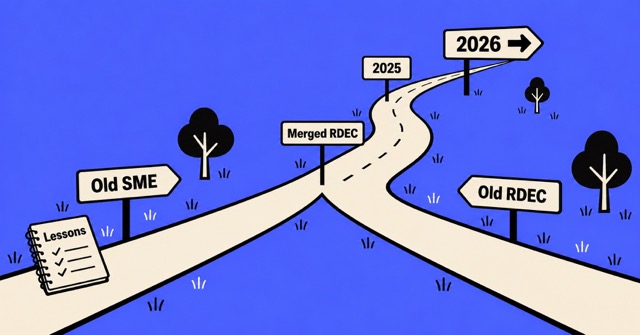
2025 was a pivotal year for UK R&D tax relief. It marked the rollout of the merged R&D scheme, alongside significant updates to compliance requirements and eligibility criteria that are reshaping how claimants plan and submit claims. Following HMRC’s 2024 crackdown on fraud and error, businesses are now confronting the real-world impact of these reforms, and claimant behaviour is already shifting in response.
In this edition, we explore what these changes mean for businesses and advisers, how organisations are navigating an increasingly compliance-driven landscape, and the opportunities and challenges that 2026 may bring for the R&D tax relief regime.
What Were the Key Changes in 2025?
The introduction of a single, merged R&D tax relief regime replaced the former RDEC and SME relief schemes from 1 April 2024. In practice, this means 2025 was the first year claims were submitted under the merged scheme, and for many claimants, it represented a significant shift in both the value of relief received and how claims must be managed.
One of the most immediate changes was the move to a single above-the-line credit. Under the merged scheme, all qualifying expenditure attracts a taxable credit of 20%, regardless of company size. While this has improved visibility of R&D support by increasing reported operating profit and making businesses appear more profitable to boards and investors, it has also introduced unfamiliar tax implications for many SMEs.
Unlike the former SME scheme, the merged credit is subject to corporation tax and must first offset any existing liabilities before any cash credit is payable. For those previously benefiting from the more generous SME relief, this has resulted in materially lower cash credits. To mitigate this, the enhanced R&D-intensive (ERIS) scheme allows qualifying companies to access a higher, payable cash credit. While this has supported some claimants, uncertainty remains for businesses falling below the threshold, leaving questions over whether current levels of R&D investment can be sustained.
Beyond the financial impact, tighter technical eligibility rules have reshaped strategic planning. For many businesses, 2025 was the first year the full impact of the overseas R&D restrictions was realised. These rules have forced difficult decisions, with some claimants bringing activity back onshore, while others are evaluating whether relocating R&D functions entirely abroad may be more sustainable. Whether these changes will successfully incentivise domestic innovation, or instead accelerate the offshoring of R&D, remains to be seen.
Subcontracted R&D continued to be complex. Relief generally sits with the contracting company rather than the subcontractor, with limited exceptions. For some companies, this has limited the scope of claimable costs and required careful structuring to ensure relief is not inadvertently lost.
Finally, compliance requirements have tightened significantly, creating a greater administrative burden. The claim notification form (CNF) has already caused businesses to miss out on relief before a claim has even been submitted. While these changes have increased workload and complexity, they have also promoted positive behavioural change. Many claimants are now engaging with the R&D claims process much earlier, strengthening internal record-keeping and planning R&D activities, resulting in more robust and defensible claims prepared well in advance.
What 2026 Means for R&D Claimants
With the merged scheme now largely settled and compliance standards significantly elevated, 2026 is shaping up as a year of consolidation rather than further reform. For claimants, this will likely mean ongoing refinement of internal processes, improving record-keeping, maintaining contemporaneous documentation, and preparing claims earlier in the accounting period to ensure they are robust and defensible.
That said, the full impact of the merged scheme remains uncertain. The legislation is still relatively new and has had limited opportunity to be tested in tribunals, so meaningful case law is scarce. As HMRC enquiries and disputes progress, greater clarity is expected to emerge throughout 2026, particularly for complex or higher-risk areas, such as overseas R&D exemptions and subcontracting arrangements. Until then, these uncertainties continue to influence commercial and strategic decision-making.
Another development to watch is the proposed Advance Assurance scheme for SMEs. In principle, this could provide much-needed confidence for smaller businesses, especially given the reported 26% decline in SME claimants compared to the prior year. If implemented effectively, it could encourage genuine claimants to re-engage with the R&D regime and help stabilise participation levels.
However, uptake will depend on perception. If the scheme is not seen as accessible, proportionate, and commercially meaningful, many SMEs may continue to regard it as offering limited practical benefit. Its success will hinge not just on availability, but on whether it genuinely reduces uncertainty and administrative friction, making it easier for businesses to plan and invest in R&D with confidence.
What About Novel?
Now that we’ve explored the key developments of 2025 and the growing complexity of the R&D tax relief landscape, it’s worth considering how advisers can adapt in practice. Over the past year, Novel has evolved alongside the new legislation, helping consultants manage claims under the merged scheme.
Novel now integrates CNF submission directly into the platform, allowing forms to be completed and submitted entirely within Novel. Beyond submission, it proactively flags outstanding notifications and sends deadline alerts for incomplete forms, giving advisers reassurance that critical deadlines are never missed.
Reflecting the merged scheme, Novel automatically determines whether a claim falls under the standard merged or ERIS regime, based on a company’s R&D intensity and size, helping to maximise available credits. The platform also incorporates overseas R&D restrictions, highlights non-UK costs, and prompts for essential compliance details such as company registration and PAYE references, ensuring advisers remain fully up to date.
By tracking legislative changes, automatically applying rate adjustments, flagging potential risks, and monitoring deadlines, Novel supports advisers and their clients in staying ahead of the curve, ensuring R&D claims are accurate, compliant, and submitted with confidence in an increasingly demanding environment.